![Seabed Mining and Resilience to Experimental Impact [logo]](/smartex/themes/smartex-NOC8X/logo.svg)
A key aim of SMARTEX is to provide objective science-based evidence to policymakers and other stakeholders to support decision making around deep-sea mining. This includes information on the baseline environment and the potential impacts and long-term effects of mining disturbance. We have achieved this in many ways across the project.
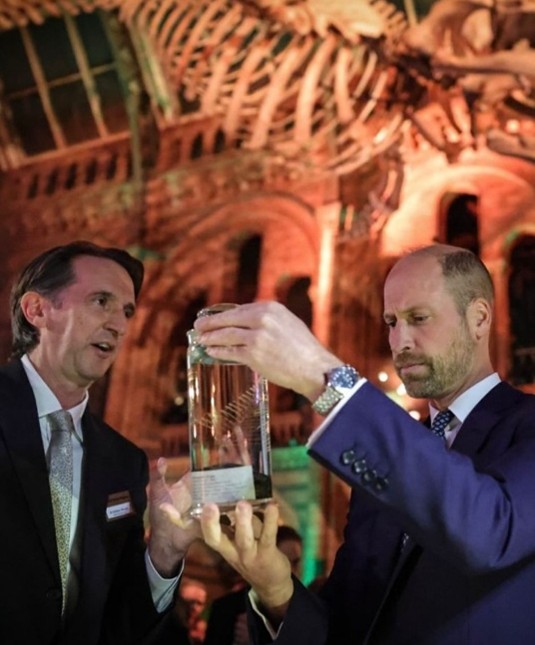
HRH the Prince of Wales holding a SMARTEX specimen with Dr. Adrian Glover (image credit: Natural History Museum)
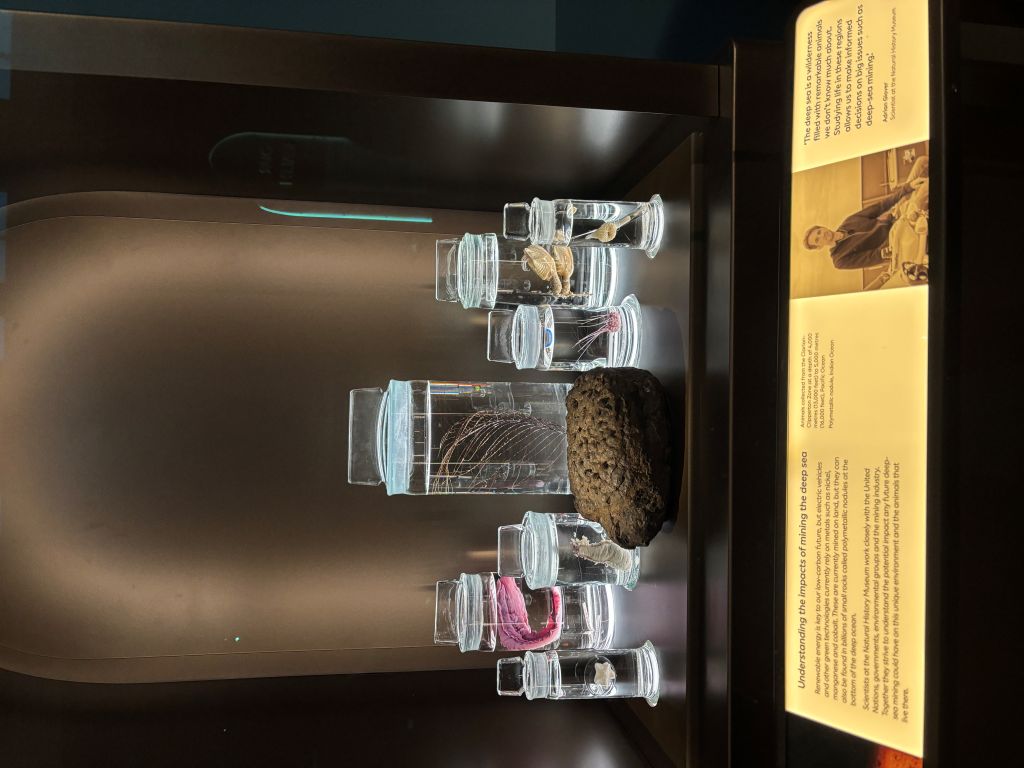
SMARTEX specimens in permanent exhibit “Our Broken Planet” at the Natural History Museum, London (Image credit: Daniel Jones)
SMARTEX Final Conference and Policy Event
SMARTEX hosted a one-day meeting, ‘Advancing the science to support deep-sea mining policy’, at the Natural History Museum in London in April 2026 to share and discuss the scientific outcomes from SMARTEX. The focus was highlighting key policy-relevant findings and providing valuable insights for decision-making on the important subject of deep-sea mining. The meeting, aimed at scientists and stakeholders but open to all was well attended with ~90 people in person and ~25 online. The attendees included representatives from the UK government, regulatory authorities, NGOs, industry and academia.
Final conference and policy event information document
The SMARTEX team presented the scientific insights from the project, covering many multidisciplinary discoveries. The morning session included the formation and composition of polymetallic nodules, the variability of abyssal currents and their potential implications, spatial and temporal variability of ecosystems from observations and modelling, discovery of new species in the Clarion Clipperton Zone (CCZ) and the reproductive and dispersal mechanisms of species in the CCZ.
After lunch, the focus moved to the impacts of deep-sea mining with presentations covering food quality changes following experimental mining, the effect of climate change on food supply, the response of seafloor sediments to mining disturbance, the impacts of sediment disturbance on the functioning of the seafloor ecosystem, recolonisation of mining tracks and biodiversity loss at a test site as well as computer modelling of ecosystem recovery and larval dispersal.
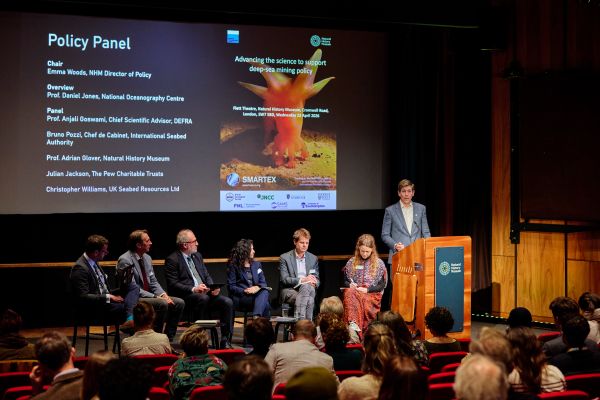
Policy panel. Copyright: Trustees of the Natural History Museum
The science sessions were followed by a panel discussion with participants from key stakeholders for deep-sea mining policy. The participants included Bruno Pozzi the Chef de Cabinet of the International Seabed Authority, Professor Anjali Goswami the Chief Scientific Advisor from the UK Government Department for Environment, Food and Rural Affairs, Julian Jackson from the Pew Charitable Trusts, Chris Williams from UK Seabed Resources, Adrian Glover and Daniel Jones from the SMARTEX project and was chaired by Emma Woods, Director of Policy and Partnerships, Natural History Museum.
An evening reception was an opportunity for informal networking and continuation of discussions between the scientists and other attendees. Exhibits included Rare Earth Rising, a sculpture by Mella Shaw incorporating a range of minerals from the deep ocean including abyssal clay collected by SMARTEX; Soundings, a film by Emma Critchley exploring the ecological, geopolitical and cultural impacts of deep-sea mining, and specimens and images from the project displayed alongside models of the systems that collected them.

Rare Earth Rising by Mella Shaw. Copyright: Trustees of the Natural History Museum
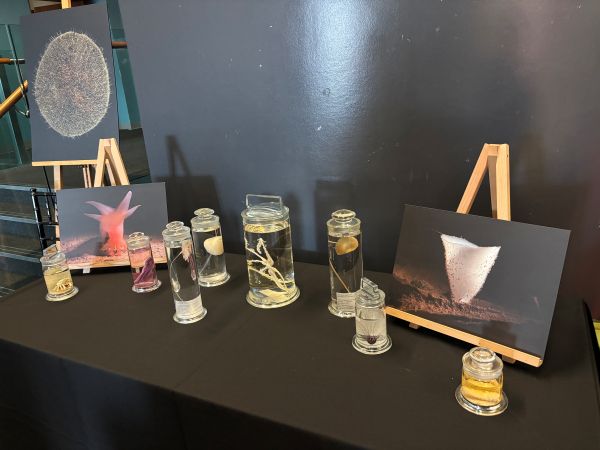
Specimens from the CCZ. Copyright: Daniel Jones
Engagement with the International Seabed Authority
SMARTEX has maintained regular engagement with the International Seabed Authority (ISA) throughout the project. The ISA Office of Environmental Management and Mineral Resources (OEMMR) joined the project’s External Advisory Board. Further engagement has included participation in ISA Council meetings, where research findings were shared through printed materials, exhibitions, and informal discussions with delegates. In particular, SMARTEX has produced and shared a summary of research highlights for 2024 and a policy brief on scaling up our current understanding of the ecology and impacts of commercial exploitation in the Clarion-Clipperton zone. A three-day photo exhibition in the ISA Council margins featured large panels of ROV imagery and posters on project objectives and outcomes. As a result of the various interactions, SMARTEX-supported research has been referenced in various formal interventions during Council sessions.
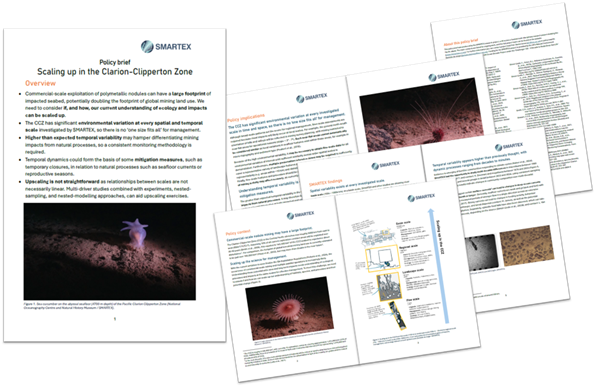
Policy brief: Scaling up in the Clarion Clipperton Zone
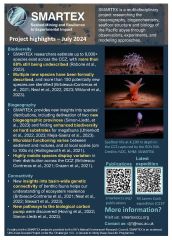
Research highlights - July 2024
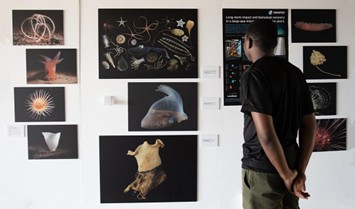
Exhibit of SMARTEX photographs at the ISA (image credit Earth Negotiations Bulletin)
SMARTEX researchers have also provided information on various topics, including on ISA standards and guidelines, through ISA expert groups (e.g. on thresholds), working groups, technical workshops (e.g. on image-based biodiversity assessment and on test-mining) and through stakeholder consultations (e.g. on the management plan for the north Mid-Atlantic Ridge and environmental impact statements for component testing). Furthermore, SMARTEX has contributed to the ISA’s Sustainable Seabed Knowledge Initiative (SSKI) by aligning project outputs with SSKI objectives and sharing data through the DeepData repository.
The project hosted a side event at the British High Commissioner’s Residence in Kingston, Jamaica, in March 2025, which brought together Member States, NGOs, industry representatives, and ISA Secretariat staff to discuss SMARTEX science and its implications for management of the Clarion-Clipperton Zone. The evening reception featured opening words by ISA Madame Secretary General Leticia Carvalho and the British High Commissioner Judith Slater, presentations by Prof. Daniel Jones and Dr. Regan Drennan, a curated exhibition, and informal networking.
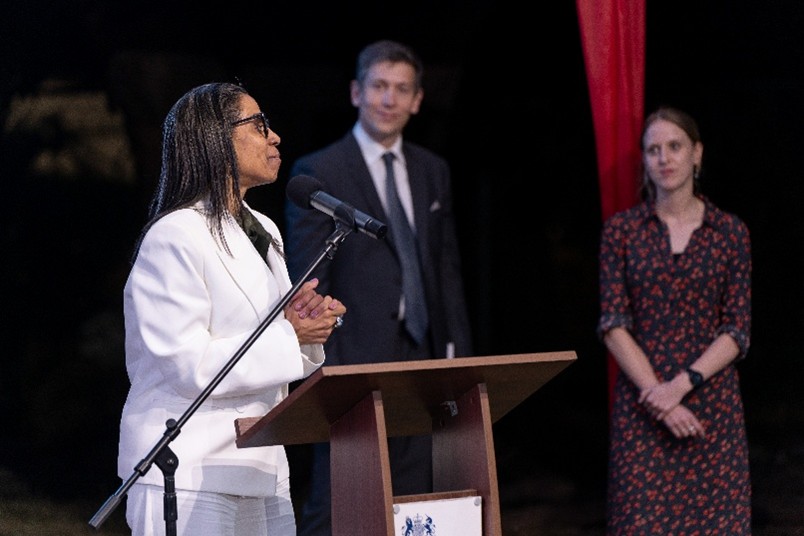
SMARTEX side event introduced by ISA Madame Secretary General Leticia Carvalho in March 2025 (image credit NOC, SMARTEX)
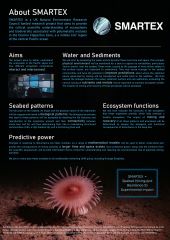
Poster about SMARTEX objectives
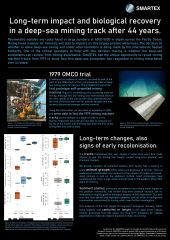
Poster on some SMARTEX results: “Long-term impact and biological recovery in a deep-sea mining track after 44 years”
Engagement with state Governments
SMARTEX has worked closely with UK government departments and agencies to ensure the latest research informs national positions on deep-sea mining. A science-policy workshop was hosted in Edinburgh in November 2024 bringing together researchers and UK policy officials to promote dialogue on various key topics including scale, recovery, and uncertainty. The project has participated in the UK Deep-Sea Mining Environmental Science Network and contributed to briefing materials for national (e.g. Parliamentary Office of Science and Technology note on DSM) and international discussions (e.g. Brief of the UN Scientific Advisory Board on DSM, and a research brief on CCZ biogeography). SMARTEX research has also been referenced in parliamentary questions including those related to the long-term effects of deep-sea mining (HL3503, HL3504, HL3506), highlighting its role in supporting evidence-based decision making.
The SMARTEX team have also provided evidence that has been used in the United States, providing evidence to senior policy makers through talks and congressional hearings (e.g. US House of Representatives).
Broader stakeholder engagement
SMARTEX is a project endorsed by the UN Decade of the Ocean under the Challenger 150 Programme.
SMARTEX has engaged with a wide range of stakeholders. SMARTEX research has been presented at a wide range of conferences, talks, webinars and exhibits (e.g. SAFE Summit, Financial Times Mining Summit, MASTS Deep-Sea Forum).
Resources
Throughout the project, SMARTEX has ensured that, once thoroughly quality controlled, its data, publications and other products are available to researchers, managers and policymakers, supporting evidence-based governance of deep-sea resources.